There’s a particular kind of professional pressure that builds quietly in communities like Folsom. On the surface, this Sacramento County city of nearly 80,000 reads as one of California’s most livable places — a community built around Folsom Lake, the American River Parkway, and master-planned neighborhoods like Empire Ranch, Willow Creek, and Broadstone that attract a highly educated, professionally active population. But beneath that polished exterior lives a substantial and growing clinical workforce with the same relentless professional obligation as their counterparts in any major urban center: staying current on BLS, ACLS, and PALS training before the AHA’s two-year renewal window closes.
The healthcare demand picture in Folsom is more complex than its suburban character might suggest. Mercy Hospital of Folsom on Riley Street serves as the community’s primary acute care facility and employs a significant clinical team with active AHA training requirements. Professionals throughout Sacramento County’s eastern corridor — commuting between Folsom and facilities like UC Davis Medical Center, Mercy General Hospital, and Sutter Roseville Medical Center — make up a workforce that crosses city and county lines daily, maintaining compliance schedules across multiple employer relationships simultaneously. In neighborhoods like Russell Ranch and the Palladio area, nurses, emergency technicians, and allied health workers are quietly navigating renewal timelines that don’t pause between shifts or accommodate unpredictable commutes.
The central question facing this workforce isn’t whether to complete their BLS, ACLS, or PALS training — it’s which format makes that process achievable without derailing everything else. Two options define the current landscape: traditional instructor-led classroom sessions and the increasingly adopted Self-Guided Learning™ model paired with CPR Verification Station™ learning centers. Both lead to successfully completing the course and receiving an AHA Course Completion eCard. This guide examines where each format excels, where each one falls short, and which approach makes the most practical sense for healthcare professionals living and working in Folsom today.
Overview of CPR Training Options in Folsom
For healthcare professionals throughout Folsom and neighboring communities like El Dorado Hills, Rancho Cordova, and Citrus Heights, two primary training pathways are available:
- Instructor-Led Training — A scheduled, in-person classroom session led by a course instructor, where both the knowledge and hands-on skills components are delivered on the same day in the same location, typically over four to eight hours depending on the program.
- Self-Guided Learning™ + CPR Verification Stations — A two-component model combining an adaptive online course completed on the learner’s own schedule with a focused, technology-evaluated skills session at a CPR Verification Station™ learning center.
Both satisfy AHA requirements and result in an AHA Course Completion eCard. The journey between starting and finishing, however, is where the two formats part ways substantially.
Traditional Instructor-Led CPR Training in Folsom
Instructor-led training has served as the standard delivery vehicle for AHA BLS, ACLS, and PALS programs throughout the Sacramento region for many years. The format is familiar: participants arrive at a scheduled training site, join a group of fellow learners, and work through AHA-approved instructional content under the direct guidance of a course instructor. Video modules alternate with hands-on skill stations where participants practice chest compressions, airway management, defibrillation protocols, and scenario-based team dynamics that increase in complexity from BLS through ACLS and PALS.
For clinical departments at Mercy Hospital of Folsom whose employers coordinate group sessions on-site, this format has historically made logistical sense. The same applies to teams at Mercy San Juan Medical Center, just west of Folsom in Carmichael, where employer-organized BLS and ACLS programs have long followed the traditional classroom structure. The friction emerges when individual professionals need to find and attend a session independently — on their own schedule, at their own initiative.
How Instructor-Led Training Works
A BLS class in Folsom’s instructor-led format typically runs two and a half to four hours. ACLS courses expand that timeline considerably — often six to eight hours — given the scope of material: advanced rhythm interpretation, pharmacology protocols, airway management techniques, and multi-role resuscitation scenarios that require extended hands-on practice. PALS programs follow a parallel structure adapted entirely to pediatric emergency care, with age-specific assessment frameworks and intervention strategies that demand careful, deliberate attention at each skill station.
Throughout the session, the trainer observes participant technique, provides real-time coaching, and confirms when the AHA’s performance standards have been met. Learners who clear all components then successfully complete the course and receive their AHA Course Completion eCard. The model is familiar, structured, and — for the right learner in the right situation — genuinely effective.
Limitations of Instructor-Led Classes
Folsom’s geography tells part of the story. The city sits at the eastern edge of Sacramento County, where Highway 50 serves as the primary artery connecting the community to Sacramento and points west. During morning and late-afternoon peak hours, that corridor fills reliably — and a healthcare professional in the Empire Ranch neighborhood who needs to reach a training site in Sacramento or Rancho Cordova for a morning ACLS class is committing to significantly more than the session itself. Round-trip travel time, parking, and the logistics of coordinating around a shift schedule all compound the time cost of a format that already demands a full day’s availability.
Schedule scarcity adds a separate layer of challenge. ACLS and PALS sessions near major Sacramento County facilities routinely book out weeks in advance, particularly during the peak renewal months when many hospital compliance cycles converge. A nurse in the Willow Creek neighborhood whose renewal deadline is approaching may discover that available classroom sessions within a reasonable distance of Folsom are already full — leaving waitlisting as the only option in a situation where deadlines don’t move. For shift workers at Mercy Hospital of Folsom or per diem clinicians working across multiple Sacramento area facilities, clearing an entire fixed day from a rotating schedule is often less a scheduling challenge than an impossibility.
The Rise of CPR Verification Stations in Folsom
Across Sacramento County’s eastern corridor, the mismatch between the traditional classroom model and the realities of modern clinical schedules has become increasingly difficult to work around. CPR Verification Stations have emerged as the practical resolution — a technology-driven shift away from group-paced, observer-dependent evaluation toward a learner-controlled, objectively measured skills verification system.
Adoption among forward-thinking healthcare organizations in the Folsom and El Dorado Hills area has grown steadily. Training providers serving this part of Sacramento County have seen the scheduling bottlenecks of the traditional model translate directly into delayed renewals and compliance stress — and have responded by making Verification Station-based skills evaluation a core part of their program offerings.
What Is a CPR Verification Station?
A CPR Verification Station™ learning center is a precision measurement system built around sensor-equipped manikins that capture real-time data on every element of CPR technique. Compression depth, rate, hand placement, full chest recoil between compressions, and the timing and volume of each ventilation are all recorded continuously and evaluated automatically against current AHA performance standards.
The result is an objective, consistent skills assessment that doesn’t fluctuate based on the instructor’s position in the room, the number of participants competing for attention, or the subjective variability that naturally comes with human observation. For clinical professionals in Folsom who are held to measurable performance standards across every aspect of their patient care work, a skills evaluation system operating on the same principle of objective measurement is a meaningful advancement.
How Self-Guided BLS, ACLS, and PALS Courses Work
The online knowledge component of the Self-Guided Learning™ model is delivered through the HeartCode® Complete course — the AHA’s approved digital curriculum covering BLS, ACLS, and PALS programs in full. What sets HeartCode® apart from conventional online video training is the intelligent system underlying its delivery: True Adaptive™ learning powered by Area9 Lyceum.
This platform continuously monitors how each participant engages with course content and adjusts the learning experience in real time based on demonstrated understanding. A seasoned critical care nurse from Folsom’s Broadstone neighborhood renewing her ACLS course doesn’t sit through foundational cardiac rhythm content she’s applied daily for six years — True Adaptive™ learning powered by Area9 Lyceum identifies her fluency with that material and advances to the content where genuine review adds value. A newer clinician working through the PALS program responds to a different version of the same course — one that reinforces foundational concepts, revisits challenging pediatric assessment frameworks, and confirms competency at each stage before moving forward.
Once HeartCode® Complete is finished, the participant schedules a focused skills session at a nearby CPR Verification Station™ learning center. The hands-on component is brief, precise, and produces an objective performance record against AHA standards. The AHA Course Completion eCard follows.
Key Advantages of CPR Verification Stations
For healthcare professionals across Folsom and neighboring communities including El Dorado Hills, Citrus Heights, and Rancho Cordova, the practical benefits of this model are concrete and immediate:
- Full schedule control — The HeartCode® Complete online course can be accessed and completed across any timeframe the learner chooses — evenings after shifts, weekend mornings, or split across multiple sessions over several days.
- Meaningful time efficiency — True Adaptive™ learning powered by Area9 Lyceum eliminates redundant review for experienced clinicians, meaningfully reducing total course time compared to the uniform pace of a full classroom day.
- Standardized, objective evaluation — CPR Verification Station™ technology applies consistent AHA performance criteria regardless of session timing, group size, or observer variability.
- Locally accessible — Brief, flexible skills sessions are far easier to schedule around a Folsom professional’s actual calendar than a blocked full-day classroom commitment.
Why Healthcare Professionals in Folsom Prefer Self-Guided Learning
Spend time talking with clinical professionals in the Russell Ranch or Willow Creek neighborhoods of Folsom and the theme is consistent: time is the resource in shortest supply. Many work rotating 12-hour shifts across multiple Sacramento County facilities. Others manage per diem schedules that make predicting availability weeks in advance essentially impossible. The idea of committing to a fixed ACLS class on a specific date — especially when that date might fall during a stretch of consecutive shifts or coincide with a family obligation — creates a level of planning stress that the renewal process simply shouldn’t require.
Self-Guided Learning™ courses eliminate that friction without any sacrifice in training quality. A paramedic based near the American River Parkway can complete the BLS program online across three evenings at home, then book a 90-minute skills session at a nearby CPR Verification Station™ location when the week cooperates. A physical therapist rotating between Folsom and El Dorado Hills outpatient clinics can work through the ACLS course online between patient appointments over two weeks, then handle the hands-on component at a time and place that fits her schedule — not an arbitrary classroom calendar. That’s not a compromise. It’s simply a better-designed system.
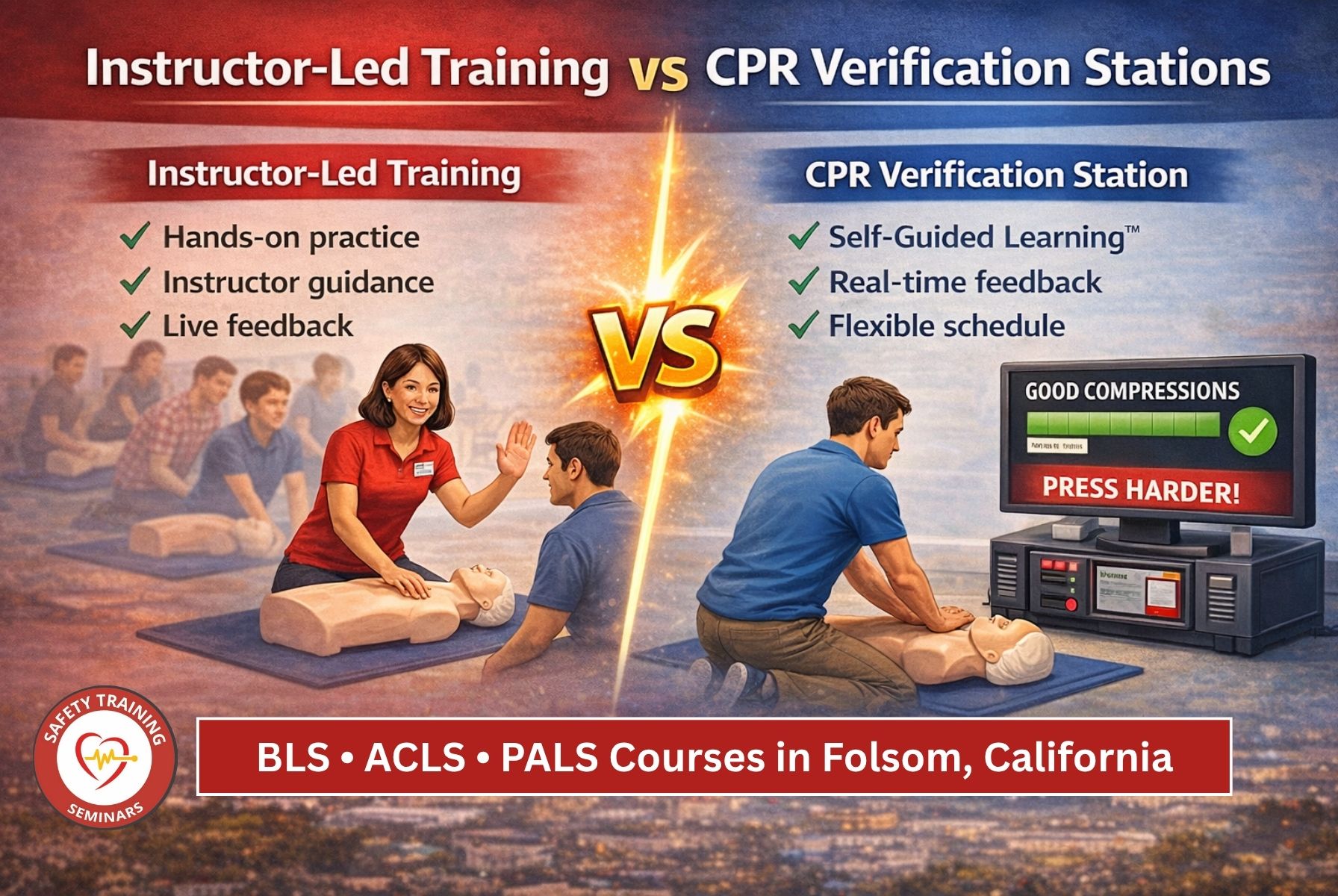
Instructor-Led vs. CPR Verification Stations: Side-by-Side Comparison
The contrast between these two formats comes into focus clearly when you look at what each one actually requires from the learner. Instructor-led training asks participants to clear a fixed block of time — typically a full day for ACLS or PALS — travel to a specific location, and learn at a uniform pace alongside everyone else in the room, regardless of how much or how little of the material they already know. The format serves the provider’s logistics, not the learner’s schedule or prior experience.
Self-Guided Learning™ with CPR Verification Stations inverts that arrangement. The HeartCode® Complete online curriculum adapts to the individual learner’s demonstrated knowledge through True Adaptive™ learning. The CPR Verification Station™ skills session is brief, focused, and objectively scored. Neither component requires a full-day commitment or a specific fixed date. The flexibility gap between these two formats is substantial — and for the majority of Folsom’s working healthcare professionals, that gap is the deciding factor.
Which Option Is Better for You in Folsom?
Instructor-led training is the right fit if you’re completing an ACLS or PALS program for the very first time and benefit from the structured, group-based environment that a live course instructor provides. Some participants — particularly those new to advanced clinical scenarios — find that working through complex material alongside peers, with real-time verbal guidance available, builds a level of foundational confidence that’s harder to develop independently. If your schedule permits the commitment and you’re approaching unfamiliar material, the classroom format has genuine value.
Self-Guided Learning™ is the stronger choice if you’re renewing familiar coursework, your schedule rotates, or you need a more efficient path to completing your BLS class in Folsom, wrapping up your ACLS program before a deadline, or finishing your PALS course without sacrificing a full day off. For experienced healthcare professionals — which describes the majority of Folsom’s clinical workforce — this is the format that was built for real working life.
Local Demand for CPR BLS, ACLS, and PALS Training in Folsom
The clinical renewal pipeline in and around Folsom is active and continuous. Mercy Hospital of Folsom is the community’s primary acute care facility and a consistent source of BLS, ACLS Course, and PALS renewal demand across its nursing, respiratory, and emergency teams. Professionals regularly commute to Sutter Roseville Medical Center, Kaiser Permanente Roseville Medical Center, UC Davis Medical Center in Sacramento, and Mercy San Juan Medical Center in Carmichael — all of which maintain their own active compliance schedules for AHA-trained clinical staff.
The Folsom Fire Department serves the community’s emergency response needs and contributes its own share of first responders to the local AHA renewal cycle. With two-year renewal requirements running continuously across all of these organizations simultaneously, demand for accessible CPR training near Folsom remains consistent and substantial throughout the year. The growing preference for flexible, technology-supported training reflects a workforce that has clearly outpaced the scheduling assumptions embedded in the traditional classroom model.
How Safety Training Seminars Supports Modern CPR Training
Safety Training Seminars serves healthcare professionals across Folsom, El Dorado Hills, Citrus Heights, Rancho Cordova, and the broader Sacramento County region by offering both instructor-led options and the Self-Guided Learning™ model supported by CPR Verification Station™ learning centers — ensuring every learner has a pathway that works for their schedule and experience level.
The full program offering includes BLS, ACLS, PALS, NRP, and First Aid, covering the complete range of AHA training requirements across clinical and non-clinical roles. The combination of quality curriculum, genuine scheduling flexibility, and accessible local skills verification has made Safety Training Seminars a trusted resource for healthcare teams throughout the region — one built around what working professionals actually need rather than what’s easiest to deliver.
The Future of CPR Training in Folsom
The direction of healthcare training innovation is clear: personalized, technology-integrated learning experiences that adapt to the individual and respect the complexity of modern clinical schedules are rapidly becoming the standard, not the exception. True Adaptive™ learning powered by Area9 Lyceum and CPR Verification Stations represent the leading edge of that transformation. Healthcare organizations across Sacramento County that have already moved in this direction are seeing real results in reduced compliance delays, more efficient training processes, and better-prepared clinical teams.
For Folsom’s healthcare professionals, this isn’t a future trend to monitor from a distance. It’s an available option today — one that’s already changing how the community’s most pragmatic clinicians approach their AHA renewal requirements.
Start Your BLS, ACLS, or PALS Course in Folsom Today
Whether you’re pursuing a BLS course in Folsom for the first time or renewing your ACLS program with a deadline on the calendar, a training pathway designed for your schedule is ready. Healthcare professionals throughout Sacramento County — from Empire Ranch to Russell Ranch, from El Dorado Hills to Rancho Cordova — are already completing their programs through the Self-Guided Learning™ model, receiving their AHA Course Completion eCard, and returning to their clinical roles without the disruption of a mandatory full-day classroom commitment.
Don’t let a booked-out session or a schedule you can’t control push your renewal into non-compliance. Choose the format that fits your professional life, complete your BLS, ACLS, or PALS training in Folsom on your own terms, and stay at the standard your patients expect from you.